Super Polygon
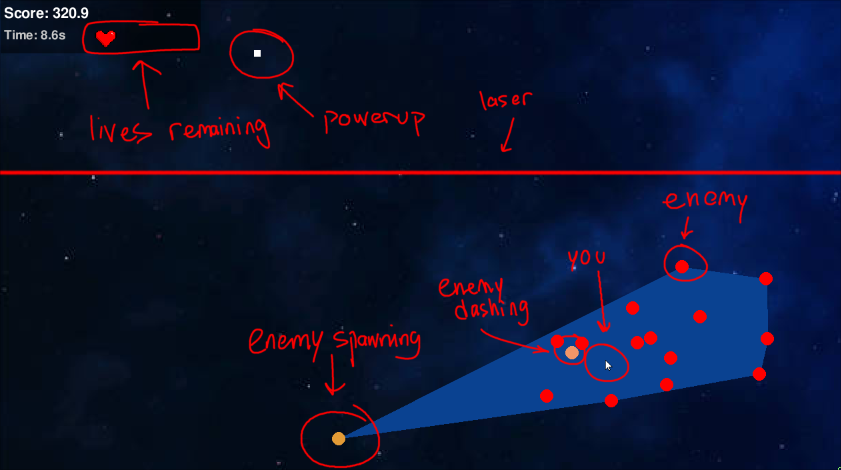
Super Polygon is a browser-based survival game built in Python with pygame and features a user service supporting authentication and a public leaderboard. The project started from asking the question: “what if the cursor was the player and enemies targeted it?””
The game was developed as a group project for the course CMPT 276: Introduction to Software Engineering, in which teams were required to extend an existing, low-quality user service and integrate it into a web application or game of their choice.
In Super Polygon, enemies follow Boid mechanics, meaning they simulate birds by maintaining cohesion, separation and alignment. The player scores points by surviving inside the convex hull of enemy positions, creating a risk–reward tradeoff, since staying closer to enemies increases score, but any collision costs one of three lives.
Powerups spawn randomly across the game area, granting temporary invulnerability, point multipliers, or freezing enemies.
Technical Design
The user service was implemented as a REST API built with FastAPI, using postgres and redis. The repositories for both the user service and the game used Github Actions for automated testing and style checks.
The game is currently offline because the free Render.com database expired. It can still be hosted locally by following the instructions in the repository README. With paid hosting, the deployment would be straightforward and more reliable.
Super Polygon was intentionally a medium-fidelity implementation. Due to course deadlines and team constraints, we frequently sacrificed code quality to expedite development, ensuring we delivered a complete, working system by the deadline. As a result, the codebase does not reflect my usual code quality standards.
My Role
I developed Super Polygon in a team of five SFU students with varying levels of experience and motivation. As the team member with the most technical experience, I naturally took on a leadership role.
This was my first time leading a team in a technical project, and it pushed me to become more comfortable with recognizing my teammates’ individual strengths and being more comfortable delegating tasks.
What I Learned
This project primarily taught me how to work on and lead in a software development project in a team. I also became more comfortable working with python-based backend development, designing REST APIs with FastAPI and working in a containerized environment with Docker.